

Customer-Facing Analytics That Stay Fast as Data Grows

When thousands of users slice dashboards unpredictably, you can't pre-aggregate every filter combination. Firebolt's sparse and aggregating indexes keep queries fast by default - without maintaining dozens of materialized views.

Why engineering teams choose Firebolt

Millisecond performance

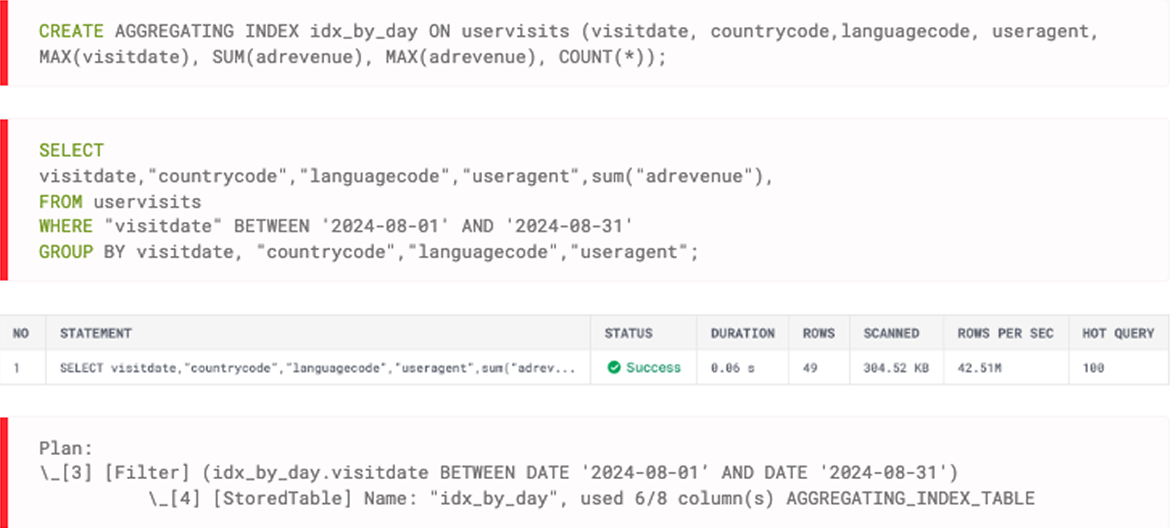
Sparse indexes prune data before scan. Aggregating indexes pre-compute results. Query optimizer adapts to your data. Millisecond response times at TB scale.

Workload isolation with elastic compute

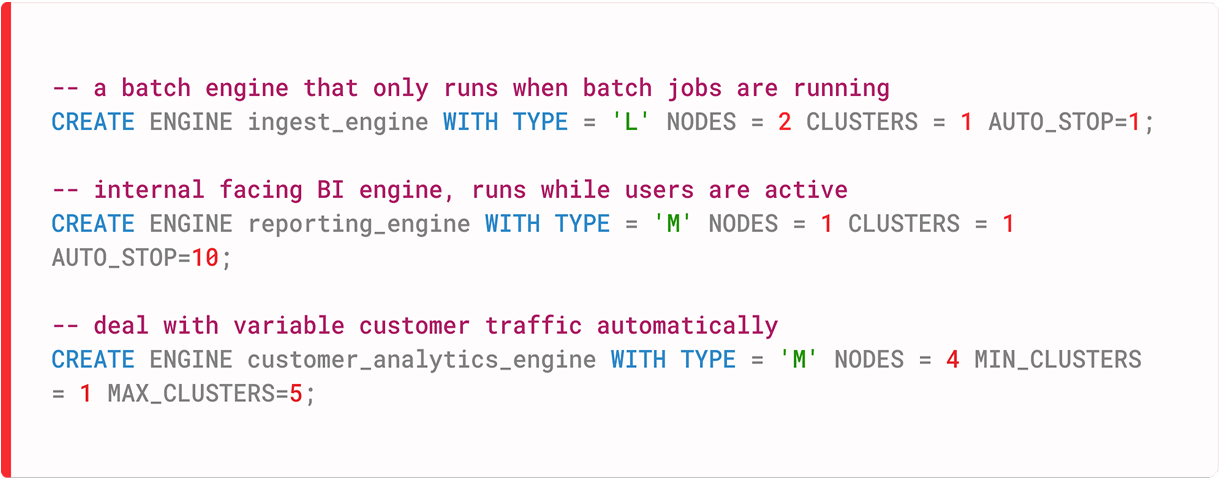
Run dashboards, batch jobs, and AI workloads on separate engines. No resource contention. No query queuing. Engines scale from 1 to 128 nodes and suspend when idle.

Standard Postgres SQL

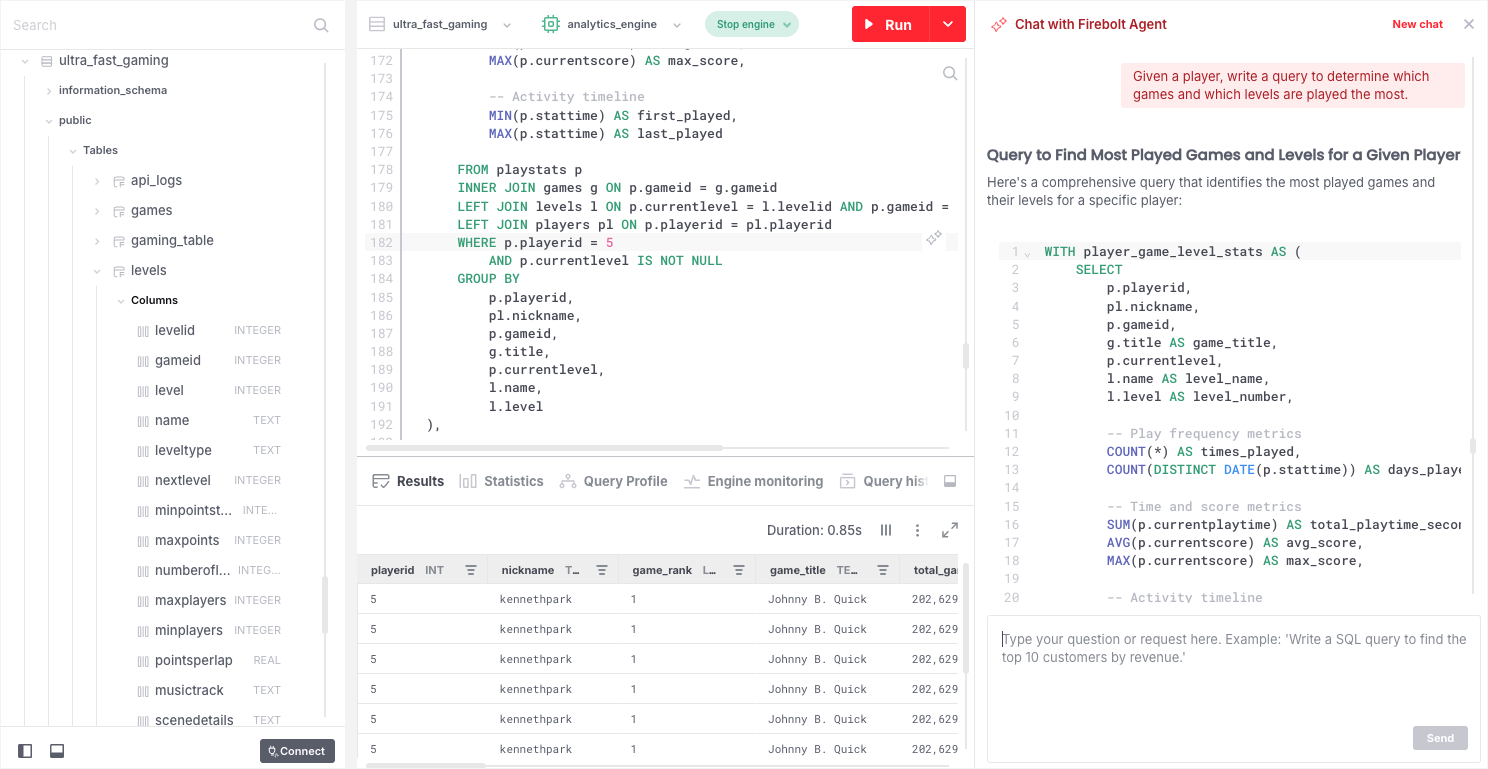
Standard Postgres syntax. No proprietary dialect. RBAC, schemas, views, CTEs, window functions all work as expected. Define infrastructure in SQL. Version control your entire platform.

Native Apache Iceberg integration

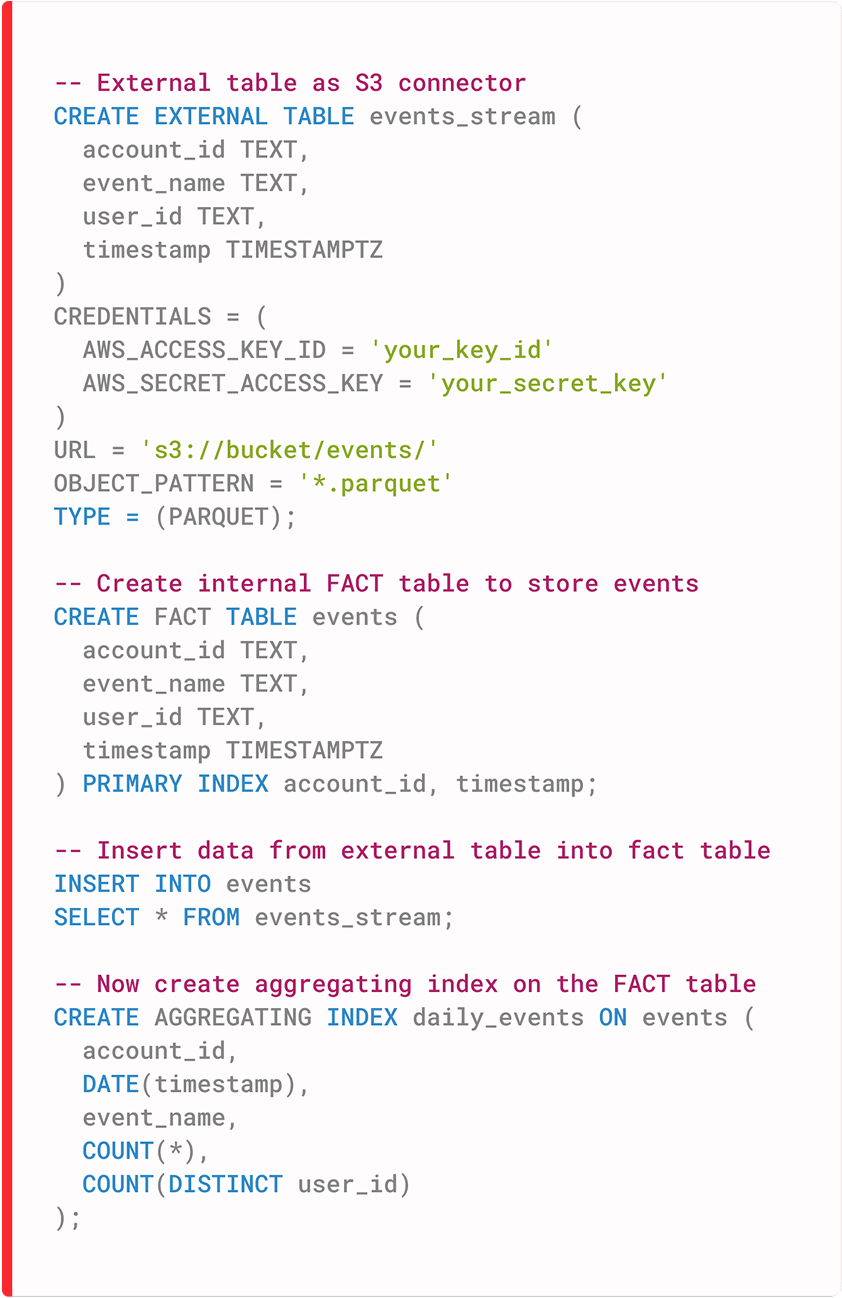
Read and write Iceberg tables with time travel and schema evolution. Works with AWS Glue, Unity Catalog, and Snowflake Open Catalog. Your data stays in S3 in open formats. No migration. No lock-in

True multi-tenancy

Account-level isolation for each customer. Dedicated databases, engines, and RBAC per tenant. Independent compute scaling. Unified billing with per-account visibility.

ACID guarantees at scale

ACID transactions with snapshot isolation. No partial writes or dirty reads, even during node failures. Transactional DDL: schema changes are atomic and never block queries

Built for AI workloads

Sustain high query throughput for AI agents and LLMs. Thousands of simultaneous queries with millisecond latency. No rate limits. No query queue.

Broad ecosystem integration

Works with your existing data and technology stack. SDKs for Python, Java, Go, Node, and .NET.  Integrate with Airflow,Confluent/Kafka, Tableau, Looker, Power BI, and more.

No setup required
No upfront sizing. No migration. No data duplication. Point Firebolt at your workloads or at Iceberg tables to run queries immediately, then scale.
Bolt Line

Frequently Asked Questions

Low latency benefits

  • Instant  Analytics: Enables businesses to act on data as it’s generated, which is crucial for industries like finance, e-commerce, and healthcare.
  • Improved Customer Experiences: Provides faster responses in applications such as recommendation engines, fraud detection, and chatbots.
  • Operational Efficiency: Reduces delays in data workflows, ensuring teams have access to the latest information for operational decisions.
  • Competitive Advantage: Accelerates insights, helping businesses stay ahead in fast-paced markets.

Key features supporting low latency

  • High-Performance Query Engines: Optimized for quick retrieval of large datasets.
  • Streaming Data Support: Processes data in real-time, ensuring minimal lag between generation and availability.
  • In-Memory Computing: Uses RAM for faster data access and processing.
  • Efficient Indexing and Partitioning: Improves data retrieval times by organizing data intelligently.
  • Scalable Architecture: Handles increased data loads without impacting performance.

What is the difference between low latency and high throughput?

Low latency focuses on minimizing delays in processing individual tasks, while high throughput emphasizes the ability to handle large volumes of data over time. Both are important for optimal data warehouse performance.

How does low latency impact real-time analytics?

Low latency ensures that data is available for analysis almost immediately after it is generated, enabling real-time decision-making and insights.

What industries benefit most from low latency in cloud analytical databases?

Industries like finance, retail, healthcare, gaming, and IoT applications greatly benefit, as they rely heavily on real-time data processing.

Can low latency be achieved with large datasets?

Yes, by using techniques like indexing, partitioning, and in-memory computing, even large datasets can be processed with low latency.

How does low latency improve customer experience?

It enables faster data-driven responses in applications like recommendation systems, fraud detection, and real-time chat support, enhancing overall user satisfaction.